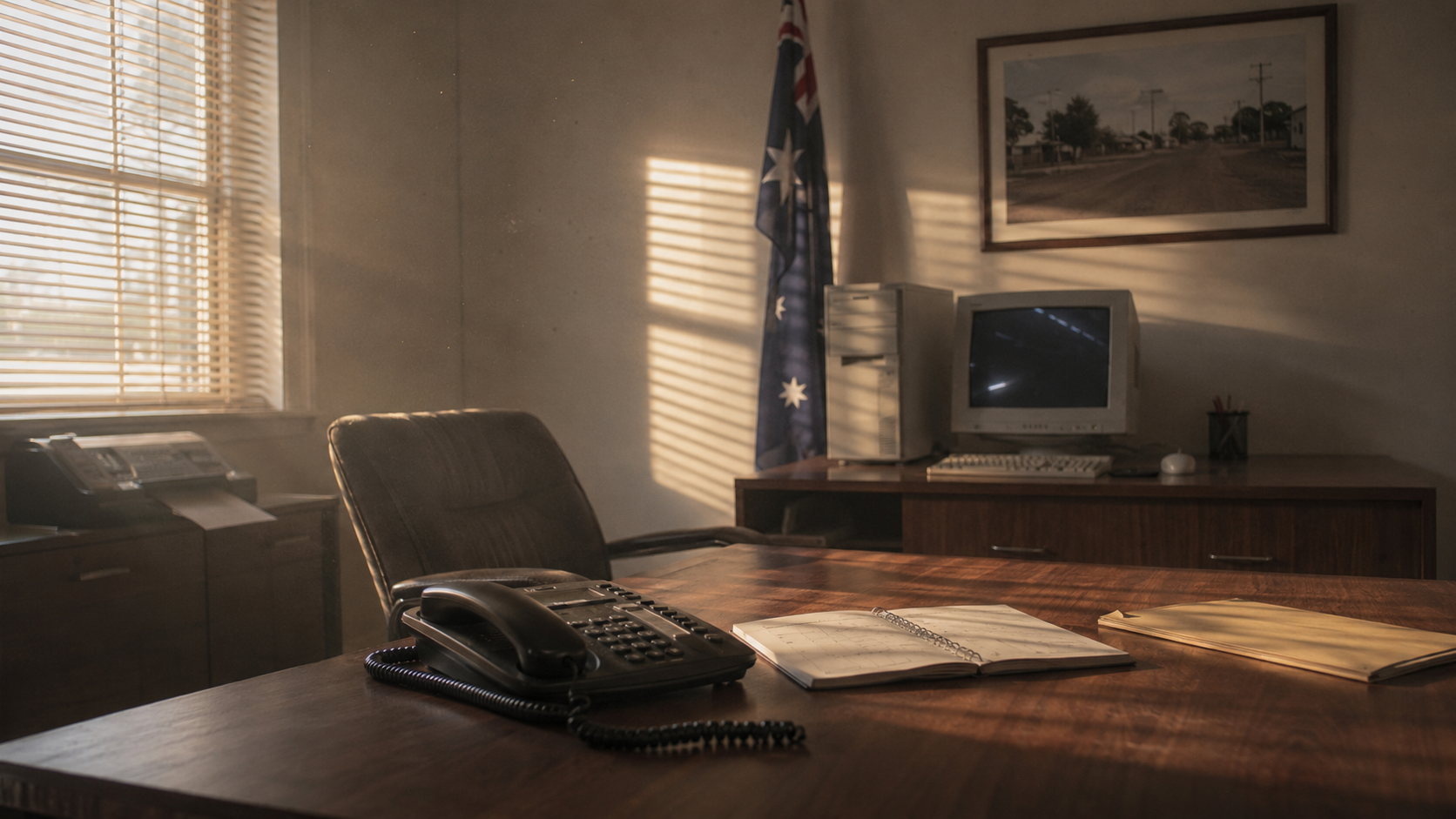
I started my first job in federal politics, in the electorate office of the Federal Minister for Agriculture, three days before 9/11. The office was in Maryborough, in the seat of Wide Bay, in southern Queensland. The Minister was the Hon Warren Truss. I was waiting for a graduate banking job that had been offered, and I had walked into the political end of my CV for what I assumed would be a structured first six months.
It was not the first six months I had been told to expect.
The towers in New York were hit late on Tuesday 11 September, Australian eastern time. Most of the country watched it live, the way you watch a thing on the late news that you cannot quite make sense of. By the time the office in Maryborough opened on Wednesday morning, every Australian had been awake to the news for hours, and the phones had already begun to ring. They did not stop, in any meaningful way, for several weeks.
This is what I learned in the days that followed.
What it actually feels like
The honest description of being inside a ministerial office during a national crisis is straightforward. It is frantic, partly because everyone is very scared and looking to you, and partly because you have no particular information you can give. Certainly nothing you can give out, even if you had it. The work, in that state, becomes the management of other people’s fear.
The phones were the first surprise. Not the volume on the day itself. The pattern over the days that followed.
A lot of people called up, and it was like a full moon. It did not matter what the subject of the call was. They were off the planet, totally irrational, sometimes ringing about something that had nothing to do with 9/11. The crisis had set them off, and they were now ringing the most senior local representative they had. The fact that the Minister’s portfolio was agriculture was largely irrelevant to the calls. The fact that we could not, in most cases, do anything about what they were ringing about was also largely irrelevant. They were calling because something needed to be said by someone, and we were the someone available.
“You’ve taken our guns off us, and now we’re at war”
Wide Bay, in 2001, was one of the highest gun-owning areas in Australia. The Howard Government’s gun buyback after Port Arthur had been five years earlier. The resentment had not gone away. It had only been waiting for a moment.
In the first week after 9/11, an awful lot of those calls were a version of the same line. You’ve taken our guns off us, and now we’re at war. It was not a complaint about Federal agricultural policy. It was a long-standing grievance reaching for a contemporary excuse, and the excuse, that week, was the most televised attack in modern history.
You cannot answer that call by arguing the policy. You answer it by listening, by acknowledging that the caller has called, by writing the call down accurately, and by moving on to the next one. Much of the work in that period was that.
The grievance arrived attached to almost any subject. A man rang one morning to complain that no doctor in Maryborough was bulk-billing. I told him he could be seen for free at the hospital outpatients. He did not like that. I explained that the Federal Government could not regulate what private GPs charged, and that the public-doctor option at the hospital was, in effect, the answer to the problem he had just described. Well, you regulate guns, he said, and hung up. The buyback was five years gone. It was still the first thing reached for.
Tampa, before the legislation existed
The MV Tampa had been resolved physically, but not politically, by the time I started. The standoff off Christmas Island had been late August. The asylum seekers had been transferred to HMAS Manoora and the ship had sailed for Nauru in the first days of September. The legislative package that became known as the Pacific Solution did not pass the Parliament until late September, two weeks after 9/11. In the days I am describing, the legal framework was still being prepared. The public argument, however, was already running on its own steam.
The version of the Tampa argument that arrived at the front counter, in an extremely right-wing electorate, was simpler and angrier than the version on the news. Just shoot them out of the water. Just kill them all. I heard a version of that line from constituents more times than I would have predicted. The men and women saying it were not unreasonable people in the rest of their lives. They paid their rates, ran small businesses, helped their neighbours. On this question, in this week, they wanted a kind of finality that the Australian legal system was not going to deliver, and they were not interested in being told why.
The job, on those calls, was not to argue. It was difficult to explain to people that no, you cannot actually do that, and that even if it were legal, killing a boatload of people would not be moral. Mostly, the call ended somewhere short of agreement. The mechanism was the same listening, recording, and moving on.
The farmer syndrome
I have my own term for the bulk of the calls in that period, and it is probably not entirely fair to farmers, but it captures the pattern. The farmer syndrome. Someone who has been alone on a tractor for too long thinking, who arrives at what they consider a brilliant solution to a problem, and whose solution turns out to be a bit simplistic.
It is not unique to farmers. It is a feature, in different forms, of any electorate where people have time to think and not enough opportunity to be argued with. It was the dominant pattern of the calls that month. A lot of frustrated, scared people, with home-built explanations for what was happening in the world, ringing the only number they had that connected to Canberra.
The faxes I did not read
Three days into the job, I had no security clearance. There was, also, a sequence of communications coming into the office that needed to reach the Minister and that I was not authorised to read. The procedure was simple. I would take material off the secure fax, hold it at arm’s length so I could not read what was on it, and walk it across to the cleared recipient. The Deputy Prime Minister, John Anderson, and the PM’s office both rang during that period to speak to the Minister; if the Minister was available, I put the call through, and if he was not, I took the message and arranged a return call.
I do not know, even now, what was in the material I carried across. I deliberately did not read it. The point of the procedure was that I did not. What I can say is that the channel existed, that it was used, and that the distance between regional electorate office and Canberra in a national emergency was, in those weeks, smaller than I would have predicted from the outside.
Ansett, on top of the rest
On Friday 14 September, three days after 9/11, Ansett entered voluntary administration. The portfolio of the Minister for Agriculture, on its face, has nothing to do with airline insolvency. In a regional electorate office, however, every Federal portfolio is the portfolio you are dealing with this morning. Constituents whose superannuation was in Ansett shares. Constituents whose flights to medical appointments in Brisbane had been cancelled. Distressed Ansett ground staff. Small operators whose freight had collapsed overnight.
A great many of the calls were a version of the same plea. It’s our national airline. The Government has to save it. The RAAF is our national airline, of course; Ansett was a private company; and Qantas and Virgin were still in business as commercial carriers. None of that was a useful thing to say at the front counter to a constituent who had just lost their super. The job was not to correct the framing. The job was to take the call.
None of this was within the Minister’s portfolio. All of it was, for the people on the phone, the most important thing in their week. The job was to listen, write the matter down accurately, refer it to the right office, and keep going.
The subterfuge
The Minister came home for the weekends, as ministers do. The local media wanted comment on Tampa, on Ansett, on whatever the day’s issue was. Some of those interviews were welcome. Some were not. There were occasions where the practical task of the office was to manage the optics of arrival and departure. At one stage, we had him leave in the car, drive around the block, and come back in a different way, so that the media thought he had gone when he had not. The substance of the policy questions was being argued out in Canberra. The job in Maryborough, that afternoon, was to keep him free of unscheduled doorstops so that he could actually do the work.
The war widow
Not every call in those weeks was anger. An elderly lady rang one morning to ask whether a War Widow’s pension was means-tested. I looked it up in the Centrelink reference book and confirmed that it was not. The next morning she rang to ask the same question. I confirmed it again. On the third day she came into the office in person to ask it for the third time, and I photocopied the relevant page out of the book and put it in her hand. Thank you, she said. I will be able to sleep tonight.
Twenty-five years on, that exchange is one of the things from those weeks I remember most clearly. The country was sad and afraid; the office had been on the wrong end of a great many phone calls; and I had, in that one small interaction, been able to give the widow of an Australian serviceman the peace of mind to sleep. It is not the kind of moment a regional electorate office is designed for. It is also one of the things a regional electorate office is, occasionally, exactly there to do.
What the period was
I do not, in retrospect, remember those weeks as unhappy. The country was sad, and afraid, and it would stay that way for some time. Inside the office, however, the work was constant, the stakes felt unusually visible, and the gap between the front counter and the Cabinet was unusually narrow. Although it was incredibly sad, it was also, I guess, incredibly exhilarating and exciting.
That is, I think, what a regional ministerial office in a federal portfolio actually is. The constituent counter is the front. The country’s emergencies, in whichever form they reach it, are the actual job.