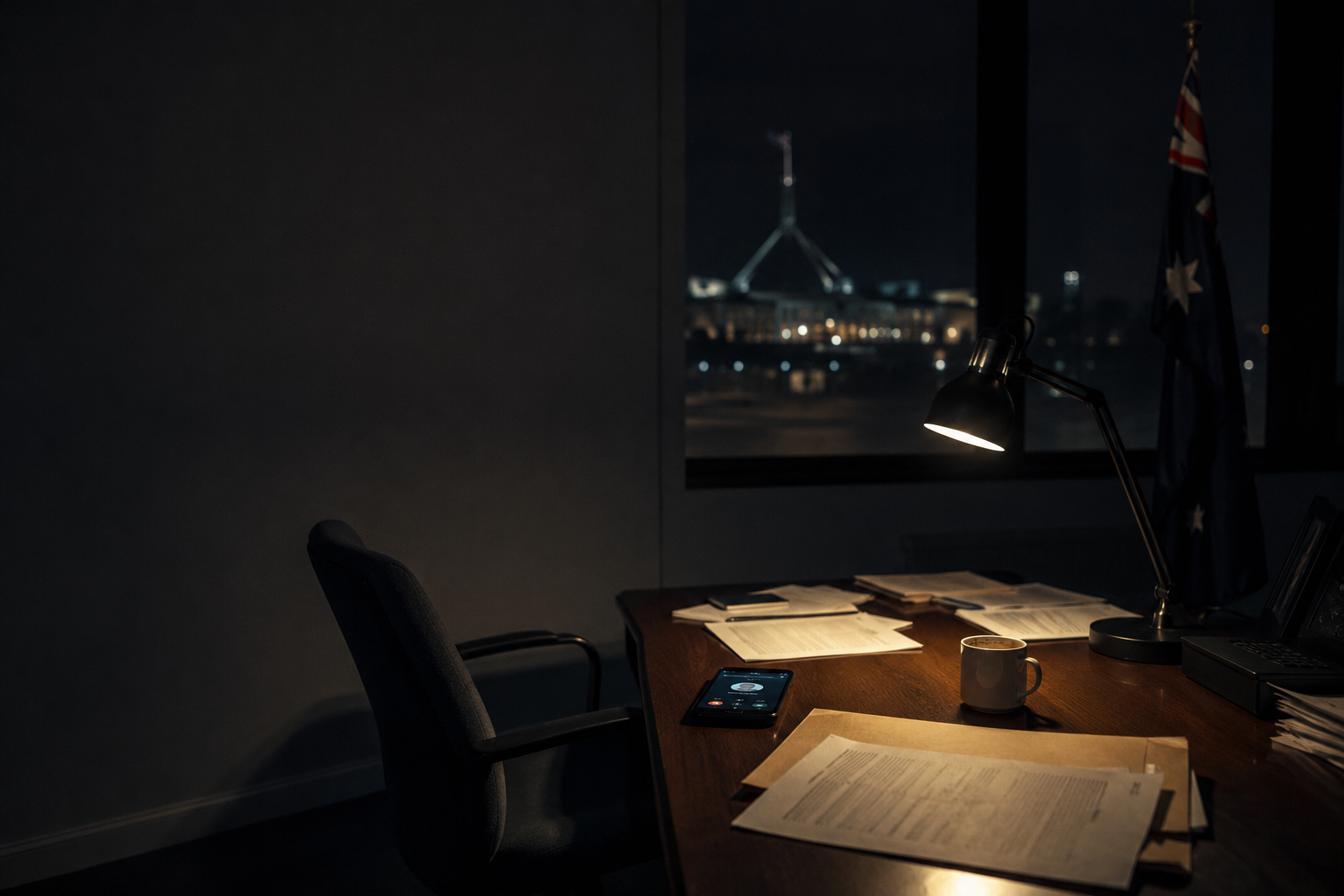
When people picture the staff who keep Australian politics running, they picture the wrong thing. They picture a public servant: someone with a grade, a desk, an enterprise agreement, a set of hours, and the ordinary protections that every other Australian worker takes for granted. That picture is wrong, and the gap between it and the reality is the whole story.
I worked in the electorate offices of Coalition members and ministers across a number of years, based at various times in Townsville, Maryborough and the Blue Mountains, and going down to Canberra for the sittings. From all of that I came away with one settled view I have never heard an outsider state plainly, so I will state it here. Political staff are on a contract that, in its terms, would not be legal for anyone else in Australia.
The contract nobody else would sign
The arrangement is straightforward once described, and most people are surprised by every part of it. You receive a basic rate of pay, and then, depending on how senior you are, a premium on top. In my experience that premium ran from somewhere around four thousand dollars a year at the junior end to perhaps thirty thousand dollars at the senior end. In exchange for it, you are expected to be available, quite literally, twenty-four hours a day, seven days a week. You can never say no. And because you can be sacked for no reason at all, with no process and no appeal worth the name, the premium is not really a payment for extra hours. It is a payment for the surrender of the ordinary right to refuse.
That last point is the one that does the work. In any normal job, the protections an employee has are what allow you to go home at the end of your shift and decline a task that is unsafe. A political staffer has none of that, and the lack of it is not a loophole someone forgot to close. It is the design.
What "you can never say no" actually means
It is easy to read a phrase like that and assume it means long hours and a demanding boss. It means more than that, and the part it really means is the part nobody talks about. The danger.
I was, more than once, after a week of late nights at Parliament, driving on black ice back to Sydney from Canberra in winter. Not because anyone judged it safe. Because the sitting had run late, the week was over, and the staffer drives. Exhaustion and ice on a winter road is exactly the combination any workplace safety regime in the country exists to prevent. There is no such regime in a political office.
Another time, because my boss had spoken for too long at an event, I ended up driving a highway in North Queensland at night with kangaroos coming at the car from both sides. My boss, in the passenger seat, had a plan. He would watch the left, I would watch the right, and I was to drive down the middle. I was also, of course, watching for the semi-trailers coming the other way, which neither of us had been allocated. That would not be accepted in any other industry. In a political office it is simply Tuesday, and the only reason it is never written up is that there is no one whose job it is to write it.
I do not tell these stories as grievances against any particular person. The bosses I worked for were not, by the standards of the place, unusual. They were operating inside a system that had taught everyone in it that the staffer is always available, that the staffer drives, and that nothing bad has happened because nothing bad has, yet. That is the danger of a culture built entirely on goodwill and stamina. It works right up until it does not.
The Wednesday night rule
Not all of the culture is about exhaustion and risk. Some of it is more subtle, and in a way more revealing. There is an unwritten rule about Wednesday evenings. On a Wednesday, Parliament rises at eight, which is early by the standards of a sitting week, and it has always been the night when the staff and the members go out to dinner and let off some of the week's frustration. Early in my time, some staffers from other offices invited me along to the rugby club to watch the State of Origin. I went. My boss rang me. Not because there was anything to be done, and not because anything had gone wrong. He rang because I had dared to leave at eight o'clock on a Wednesday night.
What I learned from the staffers around me was that the Wednesday night was not a perk. It was a necessity. As one of them put it, you come home a ball of energy every other night of a sitting week, and you need that one evening to discharge it. The system that demands everything from you on the other six days has, in effect, evolved a single sanctioned valve, and even that valve is begrudged by some of the people who depend on you.
There is a second, less obvious point hiding in the Wednesday night, and it is the reason the rule survives. An enormous amount of the real work of politics, the networking and the informal agreement-making that smooths the way for everything that later happens on the floor, happens in exactly those after-hours settings. The dinner is not time off from the job. For a great many people it is where a large part of the job actually gets done, which means the boundary between work and not-work, already thin, dissolves entirely. The members want you there for even more hours of the clock than the formal week already claims.
Why none of this is widely understood
The confusion has a simpler source than any cover-up. People do not understand the difference between political staff and public servants, and so they apply to the first group the protections that genuinely attach to the second. A public servant has a classification, a fixed framework of hours, leave, recourse and tenure. A political staffer has a premium, a phone that is never off, and a relationship that can end the moment the member decides it should. They sit in the same buildings and work on the same files, so from the outside they look like the same kind of worker. They are not. One is an employee in the full sense the word usually carries. The other has traded that status away for a few thousand dollars and the privilege of being in the room.
I do not raise this to ask for sympathy. The people who do these jobs go in with their eyes reasonably open, and many of them, myself included, would not have swapped the experience for a safer one. The work is genuinely exhilarating, and the access to how the country is actually run is something most people never get near. But there is a difference between choosing demanding work and signing away protections the rest of the workforce regards as basic, and the second is what the job asks of you. Worth saying plainly, if only so the next person who takes one of these jobs knows what the premium is really buying.