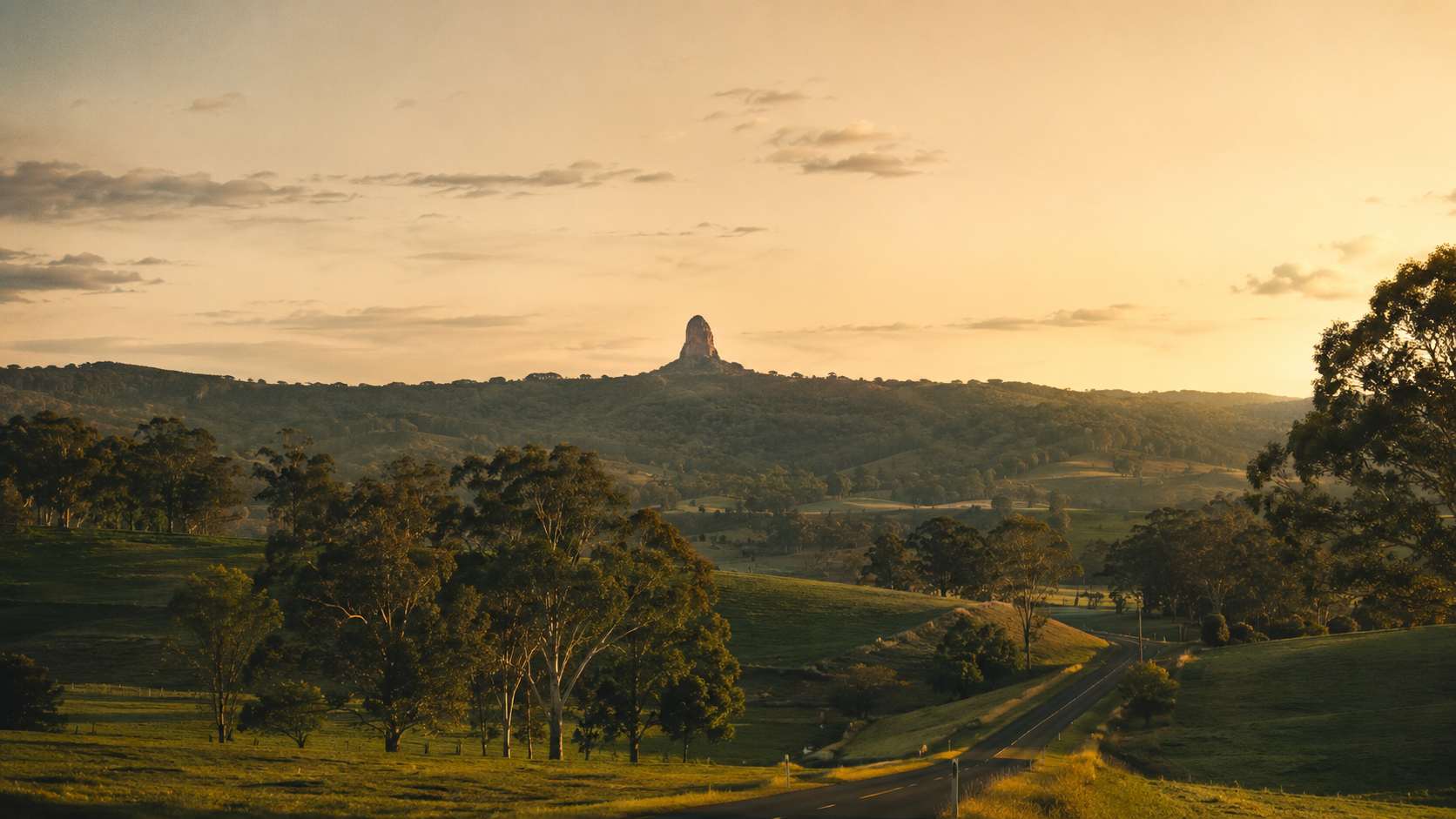
For most of my life, the drive home from Brisbane to the Mary Valley took about two hours. The road climbed up out of the coastal scarp, turned off the Bruce Highway short of Gympie, and dropped you west into the valley along a route I had been driven on as a child long before I could drive it myself. Somewhere on the last stretch, a monolith stood up on the horizon. I cannot remember a time when I did not know what it was. The first sight of it through the windscreen meant the drive was nearly done. I would have been able to tell you, without thinking, how many minutes until the turn-off, how many until the gate, how many until the kitchen.
I came back from overseas one year, around the time I was finishing my Masters, and the monolith was not there. Someone had knocked it down while I was abroad. There had been no warning to the local community that I knew of, no inquiry, no last-photograph campaign. There was simply, on the drive home, an empty stretch of sky where the thing used to be. I have written elsewhere about what that felt like. It is one of the few pieces of mine that I have always considered finished. The ABC was interested in publishing it as an opinion column. Someone higher up the chain blocked it. The essay sits in a drawer.
I want to set down here what I think the experience meant, because I have come to believe it is the same thing happening over and over in Queensland.
The pattern
The Belle Vue Hotel was demolished at midnight in April 1979 by a Deen Brothers crew working under a contract that had been written to start outside ordinary hours specifically to forestall a Supreme Court injunction. I have written about that elsewhere as well: the twelve years of inquiries, the Robin Gibson restoration proposal, the National Trust's highest classification, the cabinet decision that had been made in 1967 and was executed in 1979 with the intervening decade as theatre.
In 1982, three years later, the same firm took down Cloudland Ballroom on the Bowen Hills ridge in roughly the same way, at roughly the same hour, on roughly the same kind of overnight order, in front of, again, no opportunity for legal injunction.
The Mary Valley monolith I cannot name in this piece because the family who own the land it stood on did not invite me to make a public argument about it. What I can say is that the pattern is identical. A thing of long-standing significance in its own community is removed in conditions designed to ensure no one can stop the removal. The conditions are designed because everyone involved understands that the community would have stopped it given any procedural opportunity to do so.
What knocks down a Mary Valley landmark, a Brisbane hotel, and a Bowen Hills ballroom in the same way over a fifteen-year period is not, I want to say carefully, a uniquely Queensland malaise. It is the policy preference of a specific kind of stakeholder, in Queensland and elsewhere, who would rather not have public process get in the way of what they have decided to do.
What I think this is about
I went on, in the Mary Valley essay, about how Australia tends to go overboard with safety regulations compared to Europe. I had been in Europe looking at history. The contrast I could not stop noticing was that the European cities I had been walking around were full of structures hundreds of years older than anything in Queensland, kept alive by communities who had decided that the social value of a thing standing was greater than the marginal cost of keeping it standing. In Australia, the calculus is reversed. A building that does not meet a contemporary regulation, or a structure that has aged in a way that requires investment to remain useful, is more likely to be removed than retrofitted. The cost of bringing it up to standard is rarely weighed against the cost of its absence. The absence has no line item.
I am not arguing here against any particular safety regulation. I am pointing out that the question of how a community values its physical inheritance is, in Australia and especially in Queensland, almost entirely a question of who happens to own the title, and what they happen to want. Heritage classification provides almost no protection in practice — the Belle Vue had the National Trust's highest classification. Public consultation provides almost no protection — the twelve years of consultation about the Belle Vue altered the decision by no measurable amount. Restoration costings prepared by competent architects provide almost no protection — Gibson's were never seriously considered.
What does provide protection, in my limited experience, is direct political organisation by people who happen to care enough to spend a decade of their lives on it. The Mary River turtle and the lungfish protected the Traveston Crossing Dam site in 2009. The protection was provided by the EPBC Act, which is a piece of federal legislation, which was enforced by Peter Garrett, who is one of the very few Australian Cabinet Ministers to have refused a state premier on the public-record grounds that an environmental case had been made out and the state's case had not. The site has now been targeted again, twenty years later, by a different government, in a different decade, with the same template and the same financial logic and the same intention to remove the same physical features of the valley. Nothing about the underlying calculus has changed.
The cost we don't book
What you lose, when a monolith comes down, is not the monolith. The monolith is, in the strict sense, a pile of weathered stone. What you lose is the thread connecting you to the place. The drive home is no longer the drive home. The horizon does not signal the kitchen. The geography of a childhood is reorganised, retrospectively, around an absence. That cost is borne by everyone who knew the thing and is paid in a currency the planning system does not record.
I have, mostly, made my peace with this. The Mary Valley essay is finished. The Belle Vue piece I have already published. What I cannot make my peace with is the way the same pattern continues to happen, in the same state, often with the same firms involved, against the recommendations of the same public servants, with the same kind of public process used as cover for the same kind of decision. The lesson of Queensland heritage destruction, over fifty years, is that public process is not a safeguard. It is a procedural environment within which decisions made elsewhere are dressed up to look as if they have been arrived at fairly.
It is worth knowing this. It is worth knowing it specifically, with examples, before the next public consultation about the next heritage building begins, and before the next overnight demolition shows up in the morning paper as an item that has, formally, no public objection on record.
The cost is not the building. The cost is the thread.