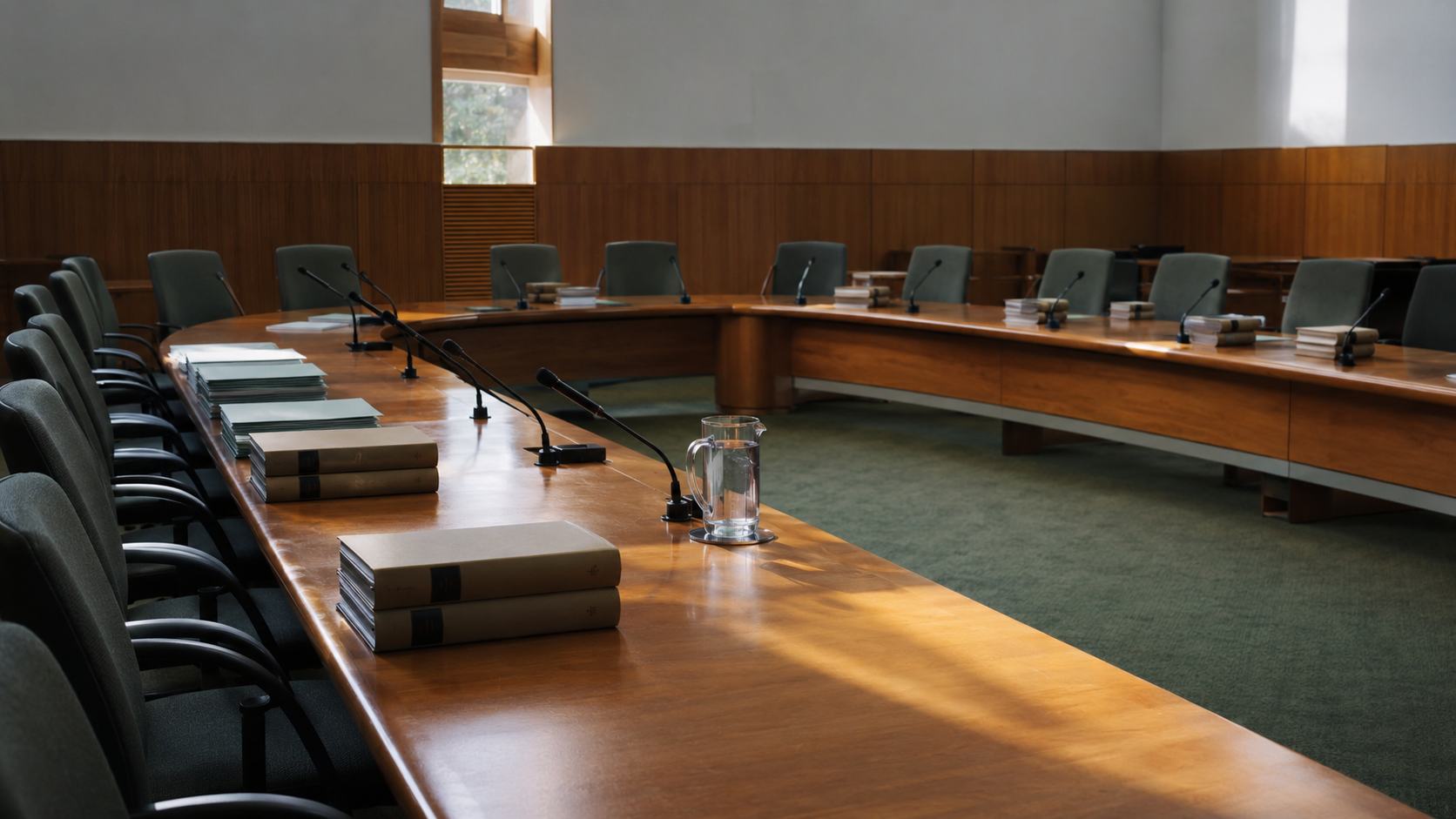
If your only window into Federal politics is the six o'clock news, you would be forgiven for thinking that the Australian Parliament is two opposed teams shouting at each other across a chamber. Question Time is loud, partisan, and televised. It also bears almost no relationship to how Australian law is actually made.
The honest figure, in my experience working in and around Federal Parliament for more than twenty years, is this: roughly eighty per cent of legislation that passes the Parliament is supported by both major parties. It is negotiated quietly, brokered through committees, and waved through with little debate and no media interest. The contested twenty per cent — the bills that turn into headlines, the ones the news leads with — is the smaller share of what the place actually does.
This is not a complaint. It is the design.
What the front pages miss
The Parliament has dozens of standing committees, joint, House and Senate. Bills are referred to them as a matter of course, evidence is taken from public servants, sector bodies, regulators, and (occasionally) the public. Reports are written. Amendments are negotiated. By the time a piece of legislation comes back to the chamber for a third reading, the position of every party has usually been settled in a series of meetings the public has never heard of and would not, in any case, find interesting.
Take the kind of regulation that sits behind every car sold in Australia. New braking standards, lane-departure warnings, speed-limiter assistance, crash-avoidance systems — the long, slow ratcheting up of mandatory safety equipment that has driven the road toll down for thirty years. None of this is contentious. The car industry wants it (predictability), the road safety researchers want it (lives), the consumer body wants it (warranty), the insurance industry wants it (claims), and both major parties want to be photographed signing it. So it gets done. There is a Senate committee report somewhere recommending it. There is a Hansard entry recording its third reading. And there is no mention of it on the news, because there is no fight.
Multiply that by every quiet bill that adjusts a tax schedule, lifts a fee, ratifies a treaty, updates a list of prohibited substances, brings airline ground-handling regulations into line with the international standard, or shifts the indexation of an old-age pension. That is most of what the Parliament does.
Why the media tells you the other story
The reason you have not heard of any of this is not a conspiracy. It is the economics of news. Conflict sells. Agreement does not. A piece headlined "Liberal and Labor agree on amended trade-mark provisions for Australian-made olive oil" sells nothing. A piece headlined "Albanese and Dutton clash over migration cap" sells everything.
The result, over time, is a public picture of Australian politics that is roughly the inverse of how the place actually operates. People see the twenty per cent, assume it is the whole, and conclude that nothing useful gets done. The truth is closer to the opposite. The thing the Parliament is best at is the boring, technical, bipartisan business of keeping a complex federation functioning. The thing it is worst at is the small set of high-profile fights that the news cycle insists on every week.
The friendships the cameras miss
Not everything in the building is a fight. There are real friendships across party lines, and there always have been. Menzies and Chifley used to share a drink most sitting days. There have been MPs whose children had godfathers from the other side of the chamber. The committees throw members together for hours at a time, and the much-ridiculed but useful committee trips — the ones the press treats as junkets, where members spend several days in a regional town visiting hospitals or border posts or research stations to investigate a piece of policy — produce a kind of professional friendship that is invisible from the press gallery. People who have spent four days in the same town asking the same questions of the same officials do not come back to Parliament hating one another. The personal animosity in Australian politics is a much smaller share of the building than it appears on television.
What this means if you actually want to influence policy
The misconception that politics is mostly fighting has practical consequences. People who want to change a piece of Commonwealth law often assume that the way to do it is to pick a party, make their case to that party, and hope that party gets into government. This is a slow and expensive plan, and it usually fails.
The faster plan, in my experience, is to assume from the outset that what you are looking for is a bipartisan agreement on a small, specific change. You make the same case to both sides. You make it on the technical merits — does this bill do what you say it does, what does the Treasury costing look like, who else supports it, what are the unintended consequences — and not on partisan grounds. You build a coalition that includes the relevant peak body, a regulator if there is one, and at least one academic or research voice. You do not lead with politics. You lead with evidence, and you offer the politicians the credit.
This is the part of the job that is not a craft of connections. It is a craft of system literacy. It involves knowing how a bill becomes a law, what a Senate committee actually does, who advises the relevant minister, when in the parliamentary cycle to ask for a meeting, and which of the dozens of staffers in the building can get a question to the right person. None of that is partisan. The good practitioners on both sides of politics work with the same evidence, talk to the same advisers, and trade information across the aisle continuously, because that is how the system was built to function.
The Parliament is, in effect, a piece of shared infrastructure that both major parties use to run the country. Their job, much of the time, is not to fight each other. Their job is to argue at the margins about the quality and direction of an institution they both intend to keep running.
The craft, in one sentence
The line I have heard often from senior public servants and ministerial advisers, when they describe how a difficult bill got across the line, is some version of: we explained to the Minister why this was in his interest. Not the Minister's party. The Minister. The person, the portfolio, the constituency, the stated objectives in the policy statement. A good policy adviser is, finally, not a partisan operator. They are a translator. They take a piece of evidence and re-state it in the language and the incentives of whichever decision-maker they are talking to.
This is the part of Australian politics the news does not show you, partly because it is not televised, partly because it is conducted in offices and corridors and at breakfast meetings, and partly because if it were televised, it would be slow and a little dull. It is also where most of the work gets done.
The Parliament you see on the news is the foam on the top of the glass. Underneath it is a much larger volume of careful, technical, bipartisan work. You should know it is there. The country runs on it.