For most of the last forty years, the medical voice in Canberra was a single voice. The Australian Medical Association had its own building down the road from the Parliament, a sustained Canberra operation, and a long-standing convention that, when a Federal Health Minister wanted to know what doctors thought, he or she rang the AMA. This was reasonable enough as far as it went. It was also, by the time I arrived in 2017, a very narrow channel through which to run the policy concerns of every doctor in the country.
The Royal Australian College of General Practitioners represents more general practitioners than any other body in the country. It speaks for the doctors most patients actually see. For decades it had no Canberra office, no permanent representation in Parliament House, and no equivalent footprint in the rooms where Federal health policy was being argued out. When I was hired to set up its inaugural Canberra office, the brief was straightforward: the College had a national membership, a credible policy capacity in Melbourne, and effectively no audience in the building where the laws were made. Fix that.
This is the story of the first six months. Specifically, of the event that almost ended the Canberra strategy in its first week, and of what we did instead.
The 1pm welcome
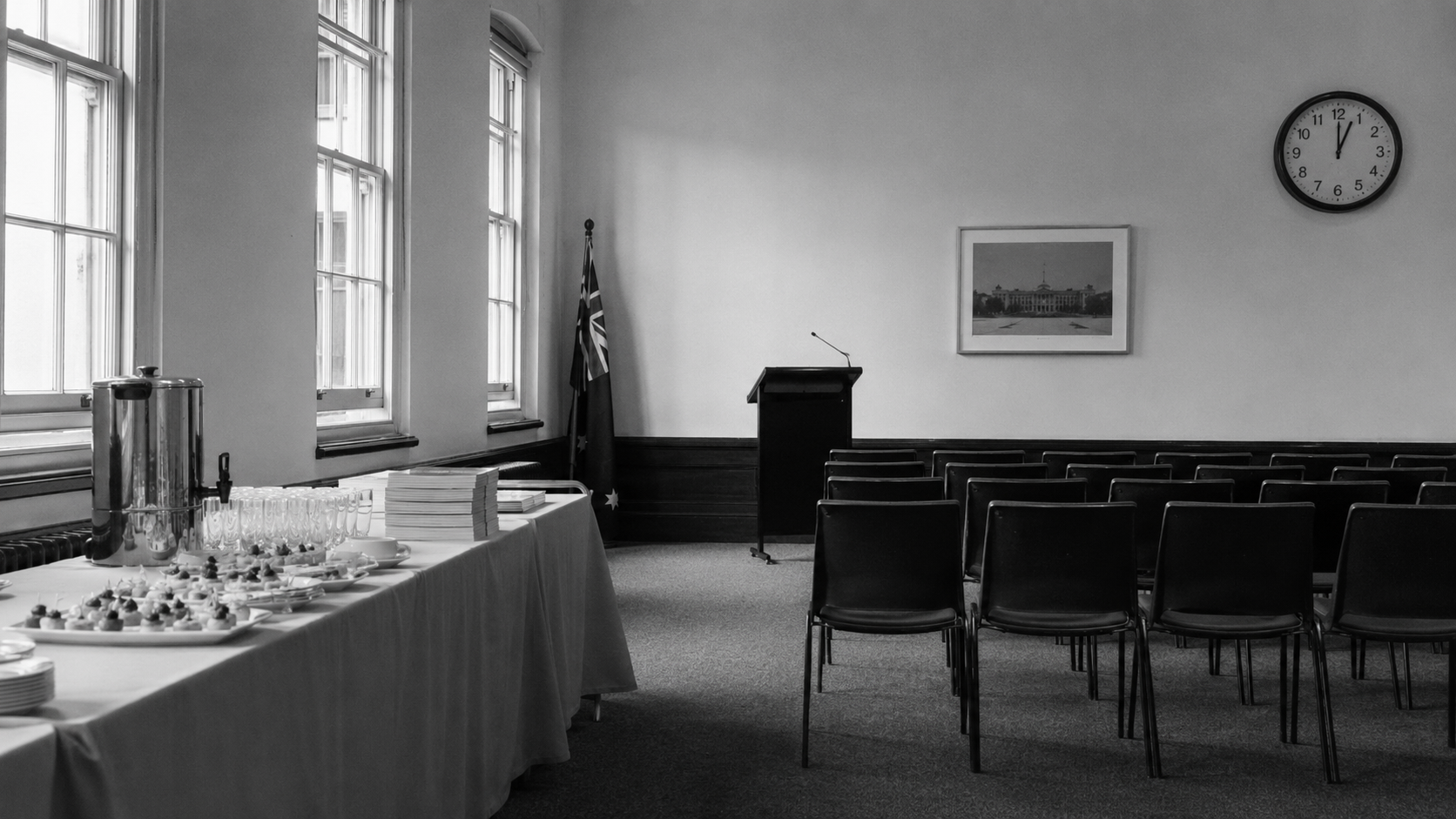
The College, before I started, had decided to mark the opening of its Canberra presence with a welcome event. Invitations were sent to every Member of Parliament and Senator. The event was scheduled for 1pm on a sitting day. Catering was booked. Speeches were drafted. The College President flew up from Melbourne. It is fair to say that everyone involved expected a strong turnout. The College, after all, represents most of the GPs in the country. There are GPs in every electorate. The relevance, on paper, was obvious.
Almost nobody came.
The team back at the office were nonplussed. They had expected a strong turnout and could not understand the empty room. They asked me, the new arrival, why.
"You held it at 1 o'clock on a sitting day," I said. "Question time's at 2. No one's allowed to leave the house."
The detail matters. The two hours before Question Time on a sitting day are the busiest period in any MP's parliamentary week. The party room briefings have wrapped up, the tactics meeting is mid-flight, last-minute briefs are landing on the desk, the whip is checking who is in the building, and the Members' wing is essentially closed for visits. The 1pm timing was, on the face of the invitation, a perfectly civilised lunch slot. In the rhythm of a sitting day it was the worst available hour. Thirty seconds with a parliamentary diary would have made that obvious.
This is the kind of mistake that organisations new to Canberra make. Not because they are foolish, but because the building has its own clock, and the clock is not visible from the outside.
What needed to change
The College had two assets: a credible national membership and a serious evidence base. What it was missing was the operating literacy required to use those assets in Canberra. That meant three things, all of them practical.
The first was learning the rhythm of the sitting calendar. There are roughly twenty sitting weeks a year. Within each week, there are windows when MPs and Senators will accept a meeting (mornings before 10, post-Question Time after 4) and windows when they will not (the two hours before Question Time, the half hour after the whips' meetings, anything that conflicts with a committee). The same applies to advisers. A meeting request that ignores the rhythm marks the requester as an outsider before the conversation begins.
The second was identifying the right interlocutors. The Health Minister and Shadow Minister sit at the top of a long structure. Below them are advisers, departmental liaison officers, parliamentary secretaries, committee chairs, backbench MPs with rural electorates and high GP shortages, Senate committee secretariats, the office of the Chief Medical Officer, and a dozen other people whose support, or whose absence of opposition, would matter to a College policy position. The job of the Canberra office, almost entirely, was knowing which of these people to brief on which question.
The third was being present. A Canberra office that opens for a launch event and then operates remotely from Melbourne is not a Canberra office. The College needed a body in the building during sitting weeks, and a phone that was returned within a sitting day.
The Health of the Nation breakfast
The College already produced an annual Health of the Nation report — a survey of general practice that, every year, said something specific and useful about the workforce, patient access, and the pressure points in primary care. It was a serious document. In the Melbourne policy team it was treated as a major piece of work. In Canberra, however, almost nobody had heard of it.
The structural fix, from a Canberra point of view, was to use the report's annual release as the College's single biggest moment in the parliamentary year. Not a 1pm welcome. A breakfast launch in the Parliament House, hosted by a Member with health credentials, attended by both the Federal Health Minister and the Shadow Minister, with the College's President speaking and the report itself handed out in hard copy.
The format works for a specific reason. A breakfast in Parliament House sits before the day's business has started. The Health Minister can attend without missing a question briefing. The Shadow Minister can attend for the same reason. Both get a photograph, both get a quote in the trade press the following morning, and the College has a fixed point in the year — every year — when both sides of Federal politics are in the same room being asked to comment on Australian general practice.
The breakfast still runs. It has run, by my count, every year since. Both Health Ministers and Shadow Ministers continue to attend. The College's policy team continues to use it as the structural anchor for the year's advocacy work in Canberra. The format is unfussy and it has held.
Have you met my president?
There was a smaller routine, almost trivial in its mechanics, that did much of the day-to-day work. When the College President was in Canberra for any reason — Senate inquiry, Ministerial meeting, committee appearance — I would walk him through Parliament House. Not in a structured tour. In the corridors, during natural transitions, between the meetings he had come for. Whenever we passed an MP or a Senator I knew, I would stop briefly. The introduction was the same every time. Have you met my president? The MP would shake the President's hand, exchange thirty seconds, and we would move on.
It is a small mechanic. It also produced, over a year, a slow accumulation of name recognition. The next time the College's name came up in a portfolio meeting, the MP could say yes, I have met him. That is not influence. It is a precondition for it.
The lesson, such as it is
I would not like to claim too much for any of this. The AMA continues to be the dominant medical voice in Canberra and probably will be for years. What changed, I think, is that the channel is now a little wider. The College's policy positions are in the room when health bills are negotiated. They appear in committee evidence. They turn up in ministerial speeches. They are part of the conversation in a way that, before 2017, they were not.
The mechanism is simple, in retrospect. It is not about connections. It is about understanding the rhythm of the sitting week, knowing who in the building has the authority to act on a given question, and being there when the question is asked. The 1pm welcome failed because it ignored those things. The breakfast worked because it accepted them. A peak body trying to influence Federal policy is, before anything else, trying to be legible to a parliamentary calendar that runs on its own clock. Once you read the clock, the rest of the work begins.
That is what a Canberra office is for.