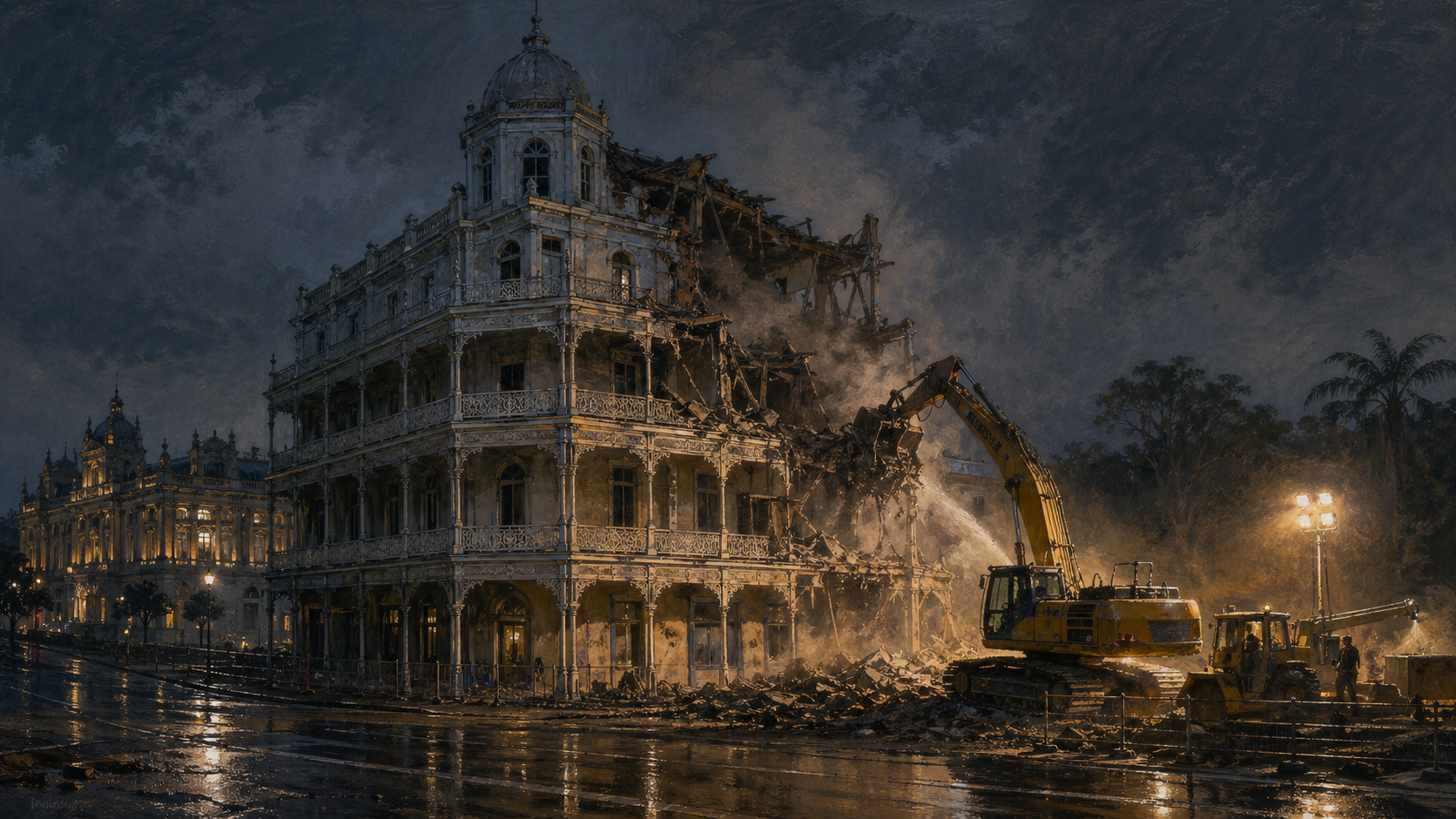
Just after midnight on 21 April 1979, a wrecking crew assembled by the Deen Brothers contracting firm pulled up on George Street in central Brisbane, opposite Parliament House and the Botanic Gardens. By the time the city was awake the next morning, the Belle Vue Hotel — the building the National Trust of Queensland had classified as one of the state's most significant pieces of nineteenth-century architecture — was substantially gone. The work continued through the day. Within a week the site was a flat brown rectangle of dirt opposite the parliamentary precinct.
The men with the hammers were doing a job they had been contracted to do. The order to begin demolition at midnight had come, in effect, from the Premier's office. The Bjelke-Petersen Government had owned the building since 1967, had been determined from the moment of acquisition to replace it with a modern office tower, and had spent twelve years working through a process of inquiries, reports, and public consultation in which the answer was always already known.
This is a short version of how the Belle Vue was lost, and what it tells you about the Queensland Government of the period. A longer version, with the parliamentary record and the contemporary press in full, is in preparation.
What the building was
The Belle Vue was opened in 1865 as the Bellevue Hotel and was rebuilt and expanded several times across the next sixty years. By the time the Government bought it in 1967, it had become something close to an unofficial annex of Parliament. Members lodged there during sittings. Press gallery journalists drank there. Cabinet meetings were sometimes finished off there. The verandahs along the George Street frontage, the cast-iron lacework, and the corner cupola were among the best surviving examples of nineteenth-century hotel architecture in the country, and the National Trust had given it the highest classification in its register.
What the Government wanted on the site was an executive office building of the kind being built in Sydney and Melbourne in the early 1970s. The two ambitions were incompatible.
The acquisition and the long delay
From the moment the Government acquired the Belle Vue in 1967, it appears that the Queensland Government was determined to demolish the hotel. The acquisition price was generous, the public justification was that the building was needed for "Government administrative purposes", and the National Party Cabinet of the day did not at any stage commission a serious feasibility study of restoration as a working hotel or as parliamentary accommodation.
What followed was twelve years of public process. Inquiries were commissioned. Reports were tabled. Public consultations were held. Heritage architects, including the late Robin Gibson, prepared restoration proposals at their own expense. The Royal Australian Institute of Architects made representations. The National Trust made representations. The Brisbane City Council, then under a Labor administration, made representations. The Brisbane press, particularly the Courier-Mail and the Telegraph, ran sustained coverage. The University of Queensland's architecture school produced a fully costed adaptive reuse design.
None of it altered the destination. By 1978 the Bjelke-Petersen Government had decided that demolition would proceed. The remaining question was when, and under what administrative cover.
The midnight order
The decision to begin work at midnight on 21 April 1979 was, by the Government's own account, a decision taken to "avoid disruption". The Minister responsible, the Hon Russ Hinze, described it on the record as "normal procedure" for a project of that size in the centre of a city. It was not normal procedure. Cabinet papers and Hansard from the period both make clear that the contracting firm was instructed to commence outside working hours specifically to forestall the possibility that protesters or heritage advocates would gather at the site and obtain a Supreme Court injunction.
That this was the actual purpose of the timing was conceded later by participants in the Cabinet process. At the time, the Government's public position was that the work had been commenced at the convenience of the contractor. The Deen Brothers firm, asked the same question, said only that they had been told when to start.
The phrase that attached itself to the demolition in the press the following week was that the building had been "knocked down like a thief in the night". The sentiment was right. The grammar was the wrong way around. It was the Government, not the building, that was behaving like a thief.
What the parliamentary record shows
The parliamentary debate of the following week is worth reading in full. The Liberal members of the coalition — Cabinet members in a National-led government — were asked, individually, whether they had been informed in advance of the timing of the demolition. Several said they had not. The Hon Llew Edwards, then Treasurer and Deputy Premier, said his information had come from the morning newspaper. Within a fortnight, two members of the Liberal heritage advisory committee had resigned in protest. None of the resignations changed any decision.
The extraordinary tendering process by which the demolition contract had been awarded — described by the Works Department of the day as normal — was at best a breaking of Westminster convention, and at worst, outright corruption. The Fitzgerald Inquiry of 1987–89, eight years later, would revisit the practices of the Works Department in some detail. The Belle Vue file was not the first item on the agenda, but it was on the agenda.
What the demolition was for
The executive office tower that had been the public justification for the midnight demolition was never built on the site. The Belle Vue block stood as a vacant public square for more than thirty years after 1979, furnished only with a bronze statue of Queen Elizabeth II holding her handbag. The land was eventually folded into the Queen's Wharf casino and entertainment precinct that began clearing the riverside in the 2010s. The official justification for the midnight order — that the site was urgently required for Government administrative purposes — was, in the most literal sense, untrue. The building was knocked down and the ground was left empty.
This is the part of the story that is hardest to write about without sounding querulous. The Belle Vue was not lost because the Government needed the land. It was lost because a particular Cabinet, in a particular period, regarded the heritage advocates and the National Trust and the press gallery as opponents to be defeated rather than as constituents to be reconciled. The building was the casualty of an institutional culture that did not, in the end, distinguish between political opposition and the public interest.
The pattern
This was not an isolated event. The Cloudland Ballroom was demolished by the same Deen Brothers crew, in the same overnight fashion, in November 1982. The proposed Traveston Crossing Dam on the Mary River, announced by the Queensland Government in 2006, would have inundated heritage homestead sites that the National Trust had also classified. It followed the same opening pattern: a long public consultation in which the answer was presented as already known. In that case, unusually, the pattern was broken. In December 2009 the Commonwealth Environment Minister refused approval under the Environment Protection and Biodiversity Conservation Act, on the grounds that the dam would threaten the Mary River turtle, the Mary River cod and the Queensland lungfish. The exception in the Traveston case was the federal jurisdiction. Without it, the homesteads would be under water and the pattern would have held.
The pattern is older than Bjelke-Petersen and outlasted him. It is, in important respects, the default pattern of Queensland heritage administration.
What is being lost in each case is not only a building. It is the thread that connects the present community to the place it lives in. In Europe, the conservation of nineteenth-century commercial buildings is so routine as to be unremarkable; the question is the engineering, not the principle. In Queensland, the conservation of a nineteenth-century commercial building is treated as a special case requiring justification, and the default presumption runs the other way. The result is a public realm in which the oldest building on most central business district streets is now late-twentieth-century concrete.
It is about people that have no love for anything but what money can bring them by knocking something down. That is not a flattering thing to say, but the documentary record will not support a more generous one.
A coda
The site of the Belle Vue is now folded into the Queen's Wharf development. There is no plaque. There is no marker. The Deen Brothers firm continued to win Government demolition contracts for many years afterwards. Russ Hinze died in 1991 and is buried at Lower Coomera, a short drive from the Hinze Dam, which carries his family's name.
The midnight order is the part of the story that endures. Everyone who was in Brisbane that week remembers the morning of 22 April 1979, and the silence of the empty space opposite the Botanic Gardens. The lesson, if there is one, is that public process is not by itself a safeguard. The public process around the Belle Vue was twelve years long, exhaustive, and entirely beside the point. The decision was made in 1967 and executed in 1979. The intervening decade was theatre.
It is worth knowing this when the next public consultation about the next heritage building begins.