By Troy Reeves
In March 2011, Horticulture Australia Limited and Growcom published a discussion paper titled Food Security (project AH09009). I was one of the authors. It was, so far as anyone involved could establish, the first substantive food security report produced in Australia.[^1] Fifteen years on is a reasonable interval at which to ask how well it held up.
The report was received politely. The ABC covered it, the rural press covered it thoroughly, and a small number of federal politicians (the then-Shadow Minister for Agriculture, the Hon Barnaby Joyce, most audibly) took it seriously enough to argue its conclusions in Parliament and on the campaign trail. The general public, so far as I could tell from the reader comments and the talkback response, did not. The proposition that a country with a cattle herd of twenty-eight million and a wheat belt that stretches from the Darling Downs to the Western Australian Mallee could ever find itself short of food struck most Australians as faintly absurd. In 2011 it was still possible to believe that.
It is not possible to believe it today.
What we wrote in 2011
The report identified four structural vulnerabilities in the Australian food system. Not one of them was original to us. All four were by 2011 well-established in the academic literature on food systems and in the working papers of the UN Food and Agriculture Organization. What we did was attempt to translate them into Australian terms and set them against Australian data.
The four were:
Population pressure on global production. The world was on track for nine billion people by mid-century. At any given moment roughly one billion were chronically undernourished. Australia is a large food exporter, but exports are a claim on global demand, not an insulation from it.
Protectionism and trade friction. The assumption that trade liberalisation would continue indefinitely, which had underpinned Australian agricultural policy since the Whitlam-era tariff cuts, was beginning to look historically contingent. Trade regimes can be written, and they can be unwritten.
Supply chain concentration. Australian food production depends on a small number of critical inputs: fuel, fertiliser, seed, and shipping. Most of these are imported, and most have undergone consolidation down to a handful of global suppliers.
The assumption that the free market would simply provide. The report was unusual for something produced by a horticultural industry body in that it argued the free market, unassisted, would not necessarily maintain domestic capability in strategically important inputs. Market signals reward cost, not resilience.
I want to be careful about claiming too much for a discussion paper I co-wrote a decade and a half ago. The argument was not prophetic. It was drawing on the FAO literature, on the 2007-08 global food price spike, and on the work of Australian agricultural economists who had been worrying at these questions for years. We took their worry and gave it a national audience.
What has actually happened since
The 2007-11 food price increases that alarmed us at the time barely register in Australian public memory now. They have been comprehensively overtaken.
COVID-19 exposed the fragility of globally concentrated supply chains in a way no modelling exercise could. Australians watched supermarket shelves empty in a week in March 2020, not because domestic production had failed, but because the logistics of getting food from paddock to shelf had briefly seized. The system recovered, but the vulnerability was no longer abstract.
Protectionism has not retreated since 2011. It has deepened. The United States has re-imposed large tariff schedules on goods that feed into the cost of food in Australia, from agricultural chemicals to steel for farm machinery. The European Union free trade agreement concluded in the past year gave Australian horticultural exporters comparatively little. The trading environment in which our report assumed the Cairns Group would continue to open markets is no longer the environment in which Australian agriculture operates.
Fertiliser. Australia's last domestic urea producer, at Gibson Island in Brisbane, ceased production. Urea is the active nitrogen input in roughly four-fifths of the world's food. The closure was a straightforward consequence of Australian energy prices, which made domestic urea production uncompetitive against Middle Eastern gas-fed plants. The market provided: it provided by reallocating production offshore. At the time of writing, with shipping in the Arabian Sea disrupted by the Iran conflict, Australian broadacre farmers face genuine uncertainty about whether they will be able to source the fertiliser to plant the winter crop.
Fuel. Australia had seven operating petroleum refineries at the start of this century. We now have two: the Viva refinery at Geelong and the Ampol refinery at Lytton in Brisbane. Every other refinery has closed, and every closure was the market providing — providing, in each case, by moving refining capacity to Singapore, South Korea, and the Gulf.
As this article was being finalised, on the evening of 15 April 2026, the Viva Geelong refinery caught fire. A gas leak in the gasoline complex ignited and flames reached sixty metres. No one was injured, and the company has since indicated that production will be back to around ninety per cent of capacity within weeks. The immediate impact on supply was absorbed by the import buffer Viva maintains.
The more useful observation, for an article of this kind, is that for a period of hours the country was a single mechanical fault away from operating one petroleum refinery. Every closure over the previous twenty-five years had been, on its own terms, the market providing. What the Geelong fire showed, briefly and in the most literal way, was the structural shape of what the market had provided.
Most consequentially, Australia has for more than a decade been in breach of its International Energy Agency treaty obligation to hold ninety days of net fuel imports in domestic reserve.[^2] That obligation was entered into by successive Australian governments, Coalition and Labor, and honoured by neither. On the eve of the current conflict Australia's fuel reserves were in the order of thirty days. We are the only OECD country not in compliance with the treaty we signed.
What we got wrong
We got the specific threats wrong. Nobody working on the 2011 paper was modelling a respiratory pandemic. Nobody was modelling a war in the Persian Gulf of the kind now underway. The report treated supply chain risk as a generic structural vulnerability, and by that measure the structural analysis has held up. But the vectors that have actually tested the system, a virus and a war, were not on any list in the paper.
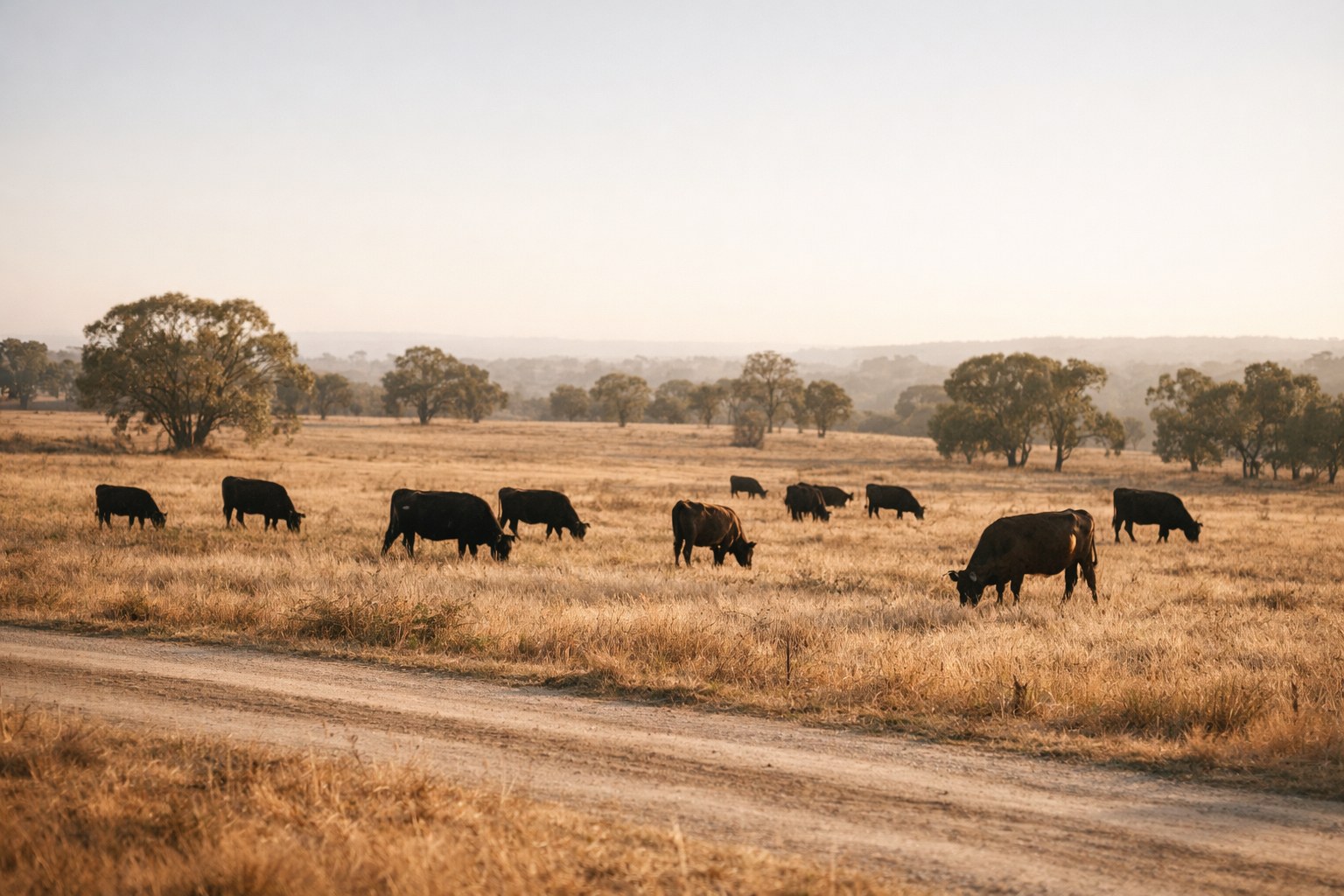
We also got the beef story wrong, and this is the one that genuinely surprises me. The report laboured the point that Australian beef production was the one thing Australians could count on: a cattle herd large enough, on pasture broad enough, that domestic supply was as close to guaranteed as anything in a food system ever is. On the numbers, that is still true. The herd is still there. The paddocks are still there.
What is not there, reliably, is the diesel to move the cattle from the paddock to the abattoir, and the diesel to move the carcass from the abattoir to the cold store. Australia's beef supply chain is a road freight supply chain, and a road freight supply chain is a diesel supply chain. In 2011 none of us thought to write a sentence about that. It did not seem to be a question that needed asking.
The policy question
I do not want to use an article like this to issue grand recommendations. Food security is a serious area of policy, with serious analysts working in it at the Department of Agriculture, at ABARES, and in the university sector, and they have considerably more current data than I do. But the structural observation from the 2011 report has not aged, and it is worth saying plainly.
A food system is not a system of food. It is a system of fuel, of fertiliser, of refrigeration, of road freight, of international shipping lanes, of domestic manufacturing capacity, and of treaty obligations kept or not kept. Australia in 2026 has allowed the market to hollow out the majority of those inputs. The market was, in each case, acting rationally on the prices it could see. The problem with prices is that they only price what is currently scarce. They do not price absence of resilience until absence of resilience becomes absence of fuel.
The 2011 discussion paper is still online. I am not particularly inclined to defend every paragraph of it. Some of it reads, now, as earnestly written by people who had not yet been through the events that made the argument obvious. But the broad claim, that Australia was letting fundamental capability erode on the assumption that it could be repurchased abroad when needed, has turned out to be the correct one.
I would rather have been wrong.
[^1]: Reeves, T., et al. Food Security Discussion Paper (AH09009), Horticulture Australia Limited / Growcom, March 2011. Full PDF available at ausveg.com.au.
[^2]: International Energy Agency, Agreement on an International Energy Program, 1974. Signatory obligation at Article 2: ninety days of net imports in emergency reserve.
[^3]: AH09009, as above. See pp. 14–22 on input concentration and pp. 28–34 on the assumption of continued trade liberalisation.