I want to set down, carefully, a small story about how a piece of mid-century Australian policy resurfaced as a contemporary federal programme. I am going to be careful with the credit. A lot of people contributed to the eventual programme, in offices I never set foot in, over a period of years after I had left the office where the conversation I am about to describe happened. The honest claim I can make is that I was there at the genesis of one particular line of thinking, and that what I contributed was a historical reference. The rest of the work was done elsewhere.
The reason I want to write about it at all is not to claim credit. It is to make a small case for the underrated role of historical knowledge in contemporary policy-making, and to set down one specific worked example of what that role can look like in practice.
The problem in the room
In the late 2000s I was working in the Townsville office of an opposition Senator who held the Shadow Minister's brief for North Queensland. The portfolio's day-to-day business included a great deal of road, rail, port, and freight policy, because regional and remote North Queensland's economy depends, in the most literal sense, on whether a truck can leave a property in the wet season.
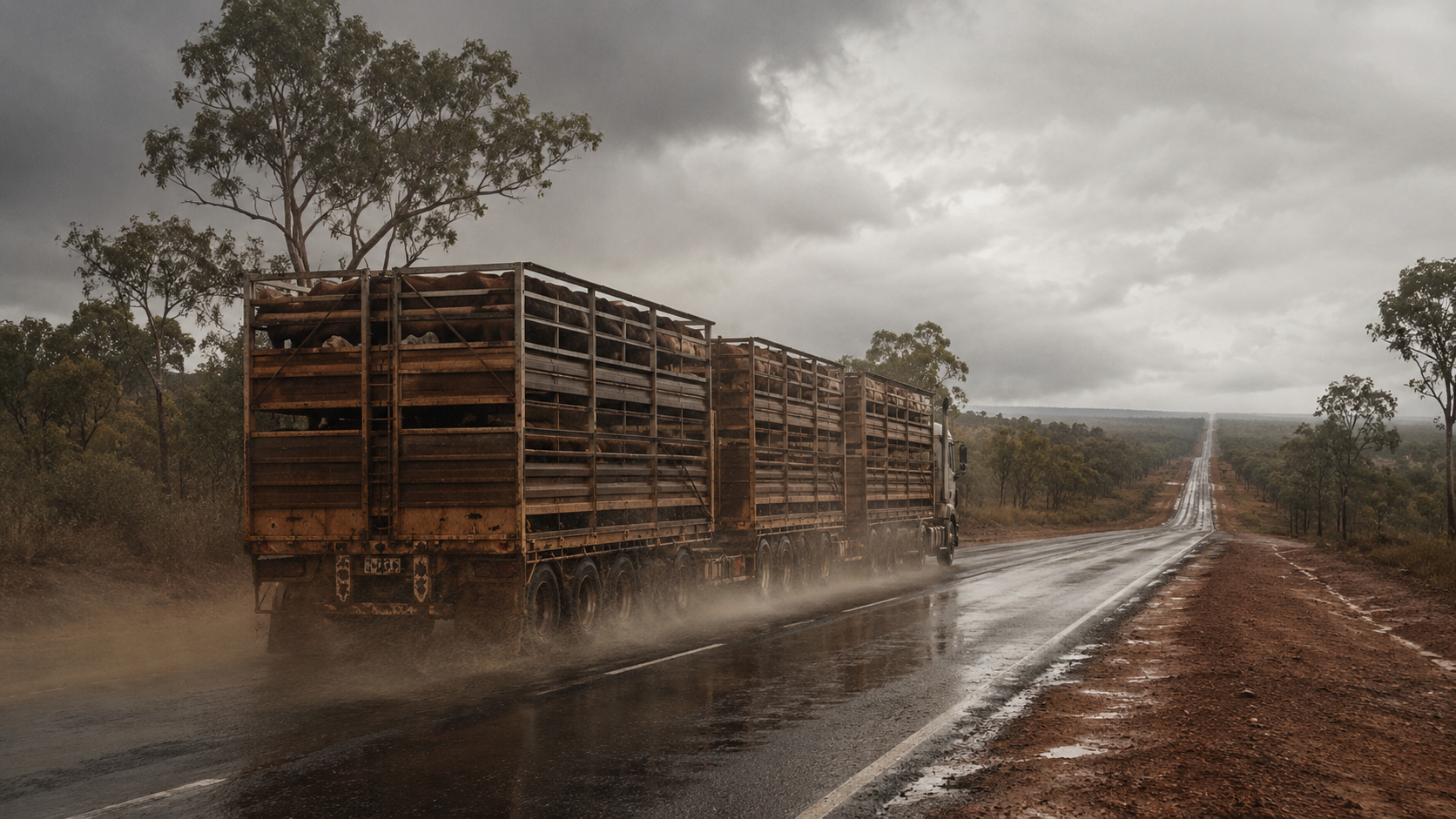
A particular pattern of complaint had been arriving at the office for some time. In the months from December to March, the unsealed sections of highway and trunk road in North Queensland become impassable to heavy vehicles. A road train cannot get a load of cattle off a property to the rail terminal at Cloncurry, or down to the meatworks at Townsville, if the road from the property gate is wet clay. The wet season is also, by accident of geography, the period when the cattle are heaviest and most marketable. The result is a small but reliable annual contraction of the regional cattle economy that nobody on either side of politics particularly wants and which is fixable, in principle, by sealing the relevant lengths of road.
The Senator and I had been talking about this. At one point, he said something to the effect of: what we need is a programme to seal these roads. I happened to be doing my Master of History at the time, on Queensland politics in the 1957-68 period, and the response that came to me was that this had been done before. You mean like the McEwen Beef Road Scheme? I said, giving it the name it was generally known by in its own time, and is still known by today among graziers and in the local North Queensland press. He had not heard of it. He asked me to write it up.
What the 1960s scheme actually was
The Beef Roads Development Programme of the 1960s was, in its original form, a Commonwealth-state cost-sharing arrangement driven by the then Country Party leader and Deputy Prime Minister John McEwen. Its purpose was the sealing of cattle-transport routes across northern Queensland, the Northern Territory, and Western Australia, with the Commonwealth funding a share of the works and the relevant state acquiring the remainder.
The scheme had a number of unusual design features that are worth noting. First, the original sealed road was typically one vehicle width — a single sealed lane down the centre of the cleared formation, with unsealed shoulders on either side. The economics of sealing across the very long distances involved did not support a full two-lane carriageway, and the one-lane design was a deliberate compromise. The road was passable in the wet to a heavy vehicle; it was not engineered as a contemporary trunk road and was not pretending to be.
Second, the route selection was driven by the freight task rather than the resident population. The roads went where the cattle were, not where the towns were. Many of the routes had small or no resident communities along them; the engineering economics worked because the user — the cattle freight operator — gained a measurable productivity benefit per kilometre sealed, even where the formal traffic counts looked thin.
Third, the programme had bipartisan acceptance at the Commonwealth level. The McEwen Country Party was the dominant force in the Coalition's regional policy thinking through the period and the design of the programme was uncontroversial. It was implemented across multiple electoral cycles and survived changes of government and changes of state ministers in the Northern Territory and Queensland.
I wrote a brief on this for the Senator that summarised the design, the financing structure, the route selection method, and the productivity rationale. The brief was, by the standards of a Shadow Minister's office, not long — three or four pages with one footnote per claim back to Cabinet papers, Commonwealth Aid Roads legislation of the period, and Hansard. The substance of it was the simple proposition that what was being asked for in 2008 had been done in the 1960s, under a Country Party Deputy PM, in roughly the same parts of Australia, with broadly the same freight task in mind.
What happened next
I left that position not long afterwards for unrelated reasons. The Coalition was in opposition at the time and did not form Commonwealth government until 2013, three or four years after the brief was written. In 2014, the Abbott Government announced a Northern Australia Beef Roads Programme with an initial allocation of approximately one hundred million dollars, which was subsequently augmented in later budget cycles. The programme's structure is recognisably a descendant of the 1960s scheme, with cost-shared Commonwealth-state works and a route selection method driven by freight productivity.
I do not know, and would not want to claim, that the brief I wrote was the single document that produced the 2014 announcement. A programme of that size and visibility has many intellectual and political authors. Senators retire, Shadow Ministers move portfolios, advisers come and go, departmental briefings circulate, sectoral lobbying campaigns build pressure, Cabinet sub-committees adjust priorities. By the time a programme is announced from a podium at a Townsville press conference, the line of intellectual descent from any particular early brief is, in honesty, untraceable. What I can say is that the conversation I described above happened, the brief was written, and the policy that emerged years later is recognisably the same shape as the policy that had existed forty years previously and that the brief reintroduced into the Coalition's policy memory.
The point worth making
The point I want to make is not about beef roads. It is about historical knowledge as a policy resource.
Contemporary politicians and their staff are very, very busy. The volume of issue-briefs landing on the desk of a Shadow Minister in a portfolio like Northern Australia is, on its own, more reading than any one human can keep up with. The result is a working environment in which policy is largely made forward from current submissions, current sectoral input, and current Treasury-modelled options. The historical record — the record of what was tried, what worked, what failed, and why — is rarely available in working memory.
This is the gap a historian can fill. Not by being clever, and not by writing a long monograph that nobody in the office has time to read, but by being able, in a meeting, to say this was done before, here is what it was called, here is the legislation that gave effect to it, here is what is documented as having worked and what is documented as having failed. The contribution is not the proposal. The contribution is the precedent.
The discipline of a Master of History is, among other things, the discipline of being able to do that quickly and accurately, with the sourcing documented and the limits of the precedent properly acknowledged. It is not, I want to say plainly, a skill the Australian Public Service universally has. It is also a skill that ministerial offices and advocacy organisations, in my experience, find unusually useful when they happen to have access to it.
That, in honesty, is what a history degree is for, on the policy side. It is not the only thing it is for, and many historians would object to the instrumental framing. But the instrumental framing is true, in addition to whatever else is true about the discipline. A great deal of what an Australian government decides to do in any given year is a slightly modified version of something an Australian government has already done. The institutional memory of what has been done, and how, and with what outcomes, is a public good that requires somebody to keep curating it.
I am not, in this piece, the person who created a programme. I am one person, among many, who happened to remember, at the right moment in a Shadow Minister's office, that a thing the office wanted to do had been done before.